
The Platformization Trap: Calling Yourself a Platform Doesn't Make You One
A framework for founders, product leaders, and buyers tired of the platformization hype. Know what you're building. Know what you're buying.


“To be, or not to be: that is the question.” Shakespeare was wrestling with existence itself. In cybersecurity today, every vendor is wrestling with a surprisingly similar one: not whether to exist, but whether to be a platform. And almost universally, they are answering it the same way: prematurely, enthusiastically, and at great cost to their own credibility.
Recently, while advising two early-stage cybersecurity startups, I found myself having a conversation I have had many times before. Both are led by sharp, experienced founders solving real, important problems. And both, almost instinctively, wanted to position themselves as platforms from the very beginning. I had to stop them. Not because having a platform vision is wrong, but because confusing vision with positioning is dangerous.
The honest truth: they are not platforms yet. They are not even products yet.
That is not an insult. It is a roadmap.
Why Everyone Claims to Be a Platform
The incentives are obvious. “Platform” commands a higher valuation multiple than “product.” It implies stickiness, ecosystem moats, and network effects that investors love. It signals to enterprise buyers that you are a long-term strategic partner, not a point solution they will eventually rip out. It gives sales teams a bigger story and marketing teams a bigger canvas.
The problem is these incentives exist whether or not the underlying architecture supports the claim. So the word gets stretched: first by large vendors trying to justify post-acquisition portfolios, then by mid-market players trying to compete with them, and finally by early-stage startups who have not shipped a single enterprise-ready product but have already decided they are building a platform.
This is the platformization trap. And almost nobody in the industry is talking about it honestly.
The Spectrum Nobody Talks About Honestly
The path to a real platform is not a leap. It is a journey with distinct, non-skippable stages:
Features → Enterprise-Ready Product → Portfolio → Portal → Platform
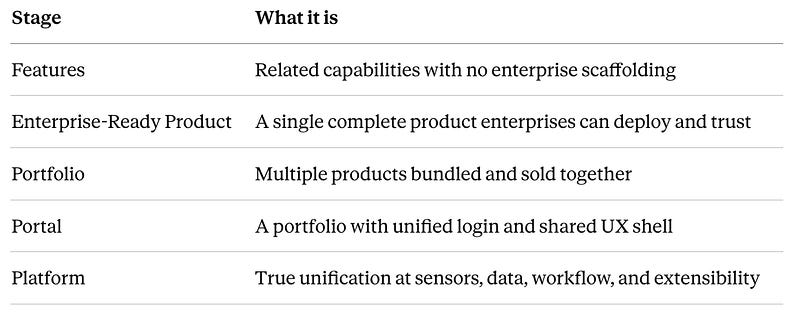
Features are a set of related capabilities: useful, demonstrable, and often impressive in a demo. But there is no enterprise scaffolding: no user and group management, no access control, no audit logging, no compliance readiness, no APIs. This is where most early-stage startups actually live, whether they admit it or not.
An Enterprise-Ready Product is the first real milestone, and it is harder to achieve than most startups admit. It requires user and group management, access control (RBAC/ABAC/PBAC), audit logging, reporting and dashboards, APIs, multi-tenancy, uptime SLAs, and compliance readiness. Without these, you have a compelling prototype, not an enterprise product. Most startups underestimate this stage by at least a year. You cannot skip it.
A Portfolio is multiple enterprise-ready products bundled and sold together. Related, but not truly integrated. A GTM construct, not an engineering one.
A Portal is a portfolio with a unified login screen and shared navigation. Integration at the surface level only. Data stores still siloed. Workflows still break at product boundaries. But it looks like a platform from the outside, at least until 18 months into the contract.
A Platform is something fundamentally different. That is what the rest of this piece is about.
The Two Traps of Premature Platformization
When startups position themselves as platforms before they have earned it, two predictable things go wrong:
The first trap: credibility erosion. Sophisticated enterprise buyers (CISOs, security architects, procurement teams) know the difference between a portal and a platform. When a company with 18 months of engineering calls itself a platform, it does not land as ambitious. It sounds naive. It signals that the founders do not fully understand the market they are entering, which raises questions about everything else they claim.
The second trap: premature horizontal expansion. Once you have positioned as a platform, you feel a relentless pressure to act like one. That means building Product B before Product A is truly enterprise-ready. You go wide before you go deep. You stop solving the original customer problem completely and start stitching together a narrative. The goal of product management is to solve the customer problem, not just a customer problem. Premature platformization is the strategic equivalent of solving a problem for many personas before deeply solving the problem for your core persona.
The right sequence: go deep first. Own your vertical completely. Only when you have multiple adjacent, enterprise-ready products that are genuinely better together should you pursue a platform strategy.
What a Real Platform Actually Is
I spent years as an Integration Solutions Architect before becoming a product leader. That background gave me a lens most PMs and founders do not have: I have seen what real platform architecture looks like from the inside, and what gets called a platform but is not.
A real cybersecurity platform unifies customer workflows at four layers. All four. Not three. Not two. All four.
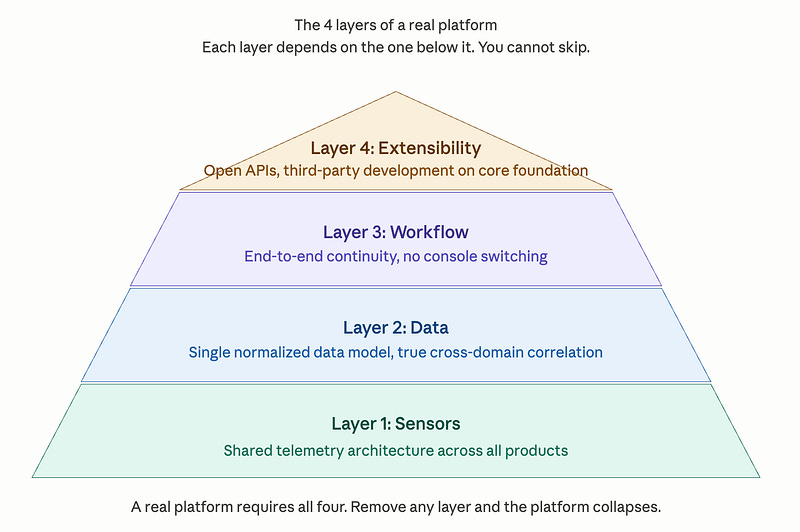
Layer 1: Sensors. A shared telemetry architecture: one unified data collection layer across all products. Not separate agents reporting to separate consoles with a shared dashboard painted on top.
Layer 2: Data. A single normalized data model: all products read and write to one schema, enabling true cross-domain correlation. Not federated queries stitching together siloed data stores in real time.
Layer 3: Workflow. End-to-end continuity: an analyst completes a full investigation without ever leaving a single pane of glass. Not SSO with a shared navigation bar calling itself a unified experience.
Layer 4: Extensibility. Others can build on the foundation: open APIs, partner integrations, third-party development on the core data and workflow layer. A true platform grows in value as more participants build on it.
Most vendors who claim to be platforms have achieved Layer 2 or Layer 3 at best, and even then, usually in the portal sense, not the platform sense.
The GTM Platform vs. The Engineering Platform
Here is the distinction almost nobody in the industry says out loud:
A platform is an engineering decision before it is a marketing decision.
When the engineering team builds on a shared foundation, the platform emerges from the inside out. It is an architectural reality before it is ever a brand claim. When the marketing team bundles products under a new brand name and announces a platform, it is declared from the outside in. The architecture did not change. The data stores are still siloed. The workflows still break at product boundaries. But the press release says “platform.”
I call this the Engineered Platform vs. the Declared Platform. Every major consolidation wave in cybersecurity has produced at least one Declared Platform: multiple acquired products, one new brand, one login screen, and a press release. Customers cannot always tell the difference at the sales stage. They learn it 18 months into the contract: when the integration tax hits, when the same threat generates three disconnected alerts across three consoles, when the analyst has five browser tabs open manually correlating events, a real platform would have already connected.
Some will point out that several market leaders called themselves platforms long before they technically were, and it worked. Fair point. But they had something most early-stage startups do not: category-defining distribution, enterprise sales forces already in the field, and timing that let them grow into the claim. Trying to replicate that playbook without that foundation is not bold. It is just premature.
The Symbiosis Test
I keep coming back to one test:
Are your products symbiotic? Genuinely better together than apart? Does the whole exceed the sum of its parts?
Not bundled together for a better price point. Not integrated enough to share a login screen. Truly symbiotic: where using Product A makes Product B meaningfully smarter, where telemetry from one domain enriches detection in another, where the customer's security posture is fundamentally stronger because these products share a foundation.
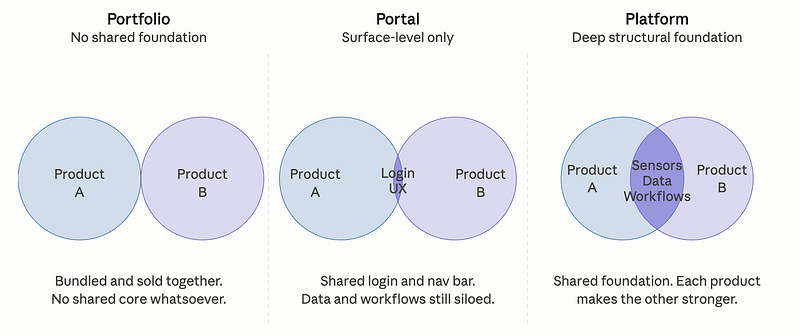
If you remove one product and the others are largely unaffected, you do not have a platform. You have a portfolio. When you can answer the symbiosis test with a clear yes, and when that foundation is unified at all 4 layers, you have earned the right to call yourself a platform.
Not Everything Needs to Be a Platform
And here is the part almost nobody says: that is okay.
Not every cybersecurity company needs to be a platform. The world needs excellent, focused, enterprise-ready products that solve specific problems deeply and completely. Some of the most valuable companies in security history were built on a single exceptional product that owned a category. They resisted the temptation to go horizontal too soon, earned their vertical completely, and then expanded thoughtfully.
The pressure to be a platform comes from every direction: investors who want the bigger multiple, sales teams who want the bigger deal, marketing teams who want the bigger story. But premature platformization does not accelerate the journey. It derails it. It disperses engineering resources, confuses the market, dilutes the original value proposition, and puts you in a competitive battle against actual platforms on their terms, not yours.
And if the strategic case alone is not enough to give you pause, consider the economics.
The Platform Tax: What Nobody Budgets For
Platform architecture is not free, even when it is the right choice. Every team at every stage pays the tax. The question is not whether to avoid it, but whether the benefits justify what you are paying.
The platform tax shows up in 3 forms:
1. The Startup Tax (pre-PMF). Paying platform infrastructure costs before you have validated what sits on top of them. Slower feature velocity. Architectural complexity before product-market clarity. Coordination overhead that consumes leadership bandwidth you do not have. For an early-stage startup, this tax can be fatal. You are building a foundation before you know what building you are constructing.
2. The Enterprise Team Tax (post-PMF, inside a large platform company). The tax is the price of scale. It shows up as adherence to shared frameworks, design systems, and architectural standards that may not be optimized for your specific product. It shows up as waiting for platform components (shared data pipelines, common APIs, unified agent frameworks) to catch up to your speed of innovation. It shows up as governance and review processes that protect platform integrity but slow individual product velocity. And it shows up as prioritization conflicts where your roadmap depends on a platform team’s roadmap, and you control neither timeline. This is not a dysfunction. It is the cost of platform integrity. But it is real, and every product leader inside a large platform company knows it.
I say this not as a theory but as someone who has paid this tax three times. At WhiteHat, we grew the platform organically: starting with DAST, then adding SAST and SCA along with DevSecOps integrations, all built on a common data architecture for a seamless UX. At Tenable, we integrated six acquired companies into a unified platform experience, rebuilding the core data architecture and platform capabilities from the ground up. At Qualys, our focus was connecting adjacent products and workflows so users could accomplish outcomes in a closed loop, without ever switching context. Each time, the Platform Tax was real. Each time, it was worth it. But it was never free.
In Part 2: Why Platform Roadmaps Never Get Prioritized (and How to Fix It) of this series, I go deeper into why this happens structurally and how to fix it.
3. The Buyer’s Tax (the customer side). Customers of false platforms pay this in integration effort, alert fatigue, and analyst context-switching. But even customers of real platforms pay an adoption and complexity tax that a sharp point product would not impose. Failed integrations, analyst hours lost to manual correlation, and shelfware risk when onboarding stalls under the weight of a platform too complex to adopt at scale: these are costs that rarely appear in the vendor’s sales deck but always appear in the customer’s reality.
Platform architecture is a strategic bet: that the long-term benefits of unification, symbiosis, and ecosystem value will outweigh the ongoing cost of the tax. For mature companies with validated products and adjacent workflows to unify, that bet usually pays off. For early-stage startups still finding their footing, it rarely does.
The Pressure-Test: 3 Questions
Before you position your company as a platform, or before you buy what someone is calling a platform, ask these 3 questions:
Are your products symbiotic? Genuinely better together, or just bundled and sold together? Can you demonstrate, with real customer data, that users of both products achieve meaningfully better outcomes than users of either alone?
Are they unified at all four layers? Sensors, data, workflow, and extensibility, or just at the login screen?
Have you gone deep enough vertically? Do you own your core problem completely before going horizontal?
If you answer no to any one of these, you are not a platform yet. Be honest about that: with your market, your investors, your team, and yourself.
Because the founders and vendors who are honest about where they are on the journey are exactly the ones I trust to eventually complete it.
To be a platform is a worthy destination. Just make sure you have earned the journey first.
Key Takeaways
The industry has a premature platformization problem. Calling yourself a platform is a marketing decision. Building one is an engineering decision. The two must be in sync.
The maturity spectrum is: Features → Enterprise-Ready Product → Portfolio → Portal → Platform. Each stage is a prerequisite for the next. None can be skipped.
A real platform unifies customer workflows at four layers: Sensors, Data, Workflow, and Extensibility.
The Symbiosis Test: make sure your products are genuinely better together, not just bundled together, before you pursue a platform strategy.
The Platform Tax is real and universal. Know what you are paying and know what you are getting in return.
Not everything needs to be a platform. Depth before breadth. Own your vertical before you go horizontal.
Vision is not positioning. Knowing where you want to go is smart. Claiming you are already there is a trap.
This is Part 1 of my ongoing series on platform strategy. Part 2: Why Platform Roadmaps Never Get Prioritized (and How to Fix It) →

I am a product leader with 20+ years of experience in enterprise software and cybersecurity. I have built and scaled cybersecurity platforms at WhiteHat, Tenable, and Qualys, and architected integration platforms at Reynolds American, Thermo Fisher, 3M, and Delta Airlines. These days, I advise and consult with startup founders, product leaders, and investors on AI, cybersecurity, product strategy, and go-to-market. What stage is your company actually at? I would love to hear your honest answer in the comments.